
I’m afraid I’m becoming a little bit too much like Jo March
“I’m so sick of people saying that love is all a woman is fit for,” she says. “But I’m so lonely.”

I’m afraid I’m becoming a little bit too much like Jo March.
Specifically, Jo March in the 2019 adaptation of Little Women.
I first watched the movie when it came out. I was 18, about to move to the United States for college, and very much bright-eyed about the possibility of all my dreams coming true.
At the time, my dream was to write novels. I was obsessed with writing. I would spend hours in my journals crafting the perfect narrative. My dream was to write a book and be a famous author.
And, just like Jo, the romance side of my life was a disaster. But I didn’t really care back then.
I didn’t get my first boyfriend until I was 20, in college (and that relationship lasted three weeks). But that’s a whole different story.
So when I watched Little Women at 18, I related strongly to Jo’s obsession with becoming a great novelist while leaving the romantic parts of life aside. My version of that obsession was finishing a book that I eventually published and starting university.
But even back then, the scene that stayed with me most was the one where Jo tells Marmee that she feels lonely.
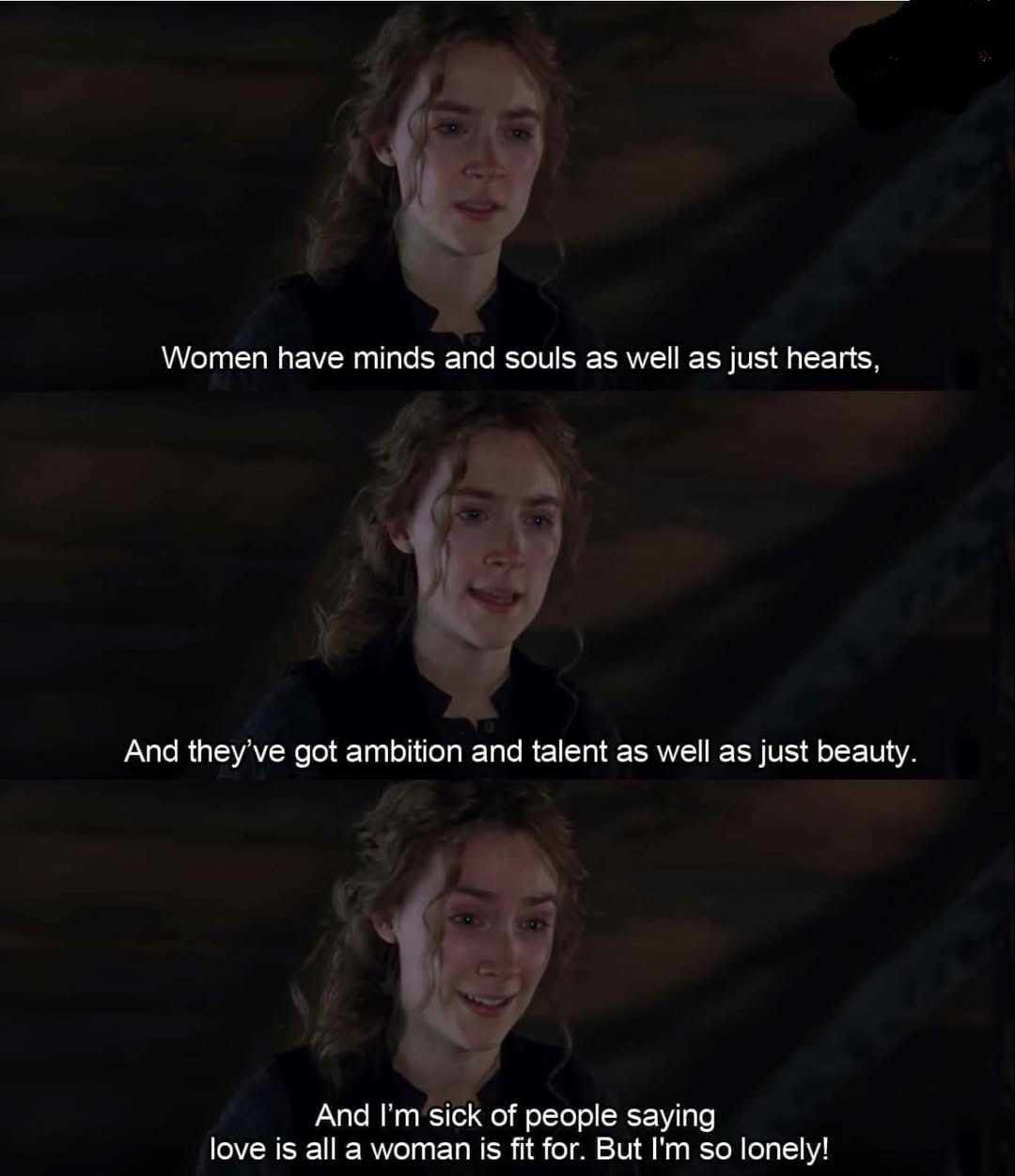
When I first watched the movie, I thought that scene meant something simple: Jo had chosen passion over love. She moved to New York. She was selling her stories. Things were working.
Recently, though, I read a Substack post that talked about the nuance of that speech.

“But even as she stands firm, she acknowledges the personal cost of her decision. The loneliness she expresses is not a fleeting sadness; it is a fundamental part of her reality as a woman who refuses to fit neatly into societal expectations.”
That interpretation resonated deeply with me because it’s exactly how I saw her: someone deeply oriented toward a dream and willing to sacrifice certain parts of life to pursue it.
“Jo March is a writer, a sister, a dreamer, a rebel. And she is lonely. That is not a contradiction - it is the most human thing of all.”
This idea — that loneliness might simply be a consequence of choosing the life you want — is what made me relate to Jo so much.
And when I first watched the movie, I thought Jo was choosing passion over love.
When Jo turns down Laurie’s proposal, she tells him she loves him, but not in the way he wants. She tells him they would only make each other miserable. She wants something different from life. That moment felt almost romantic in its own way: a woman choosing her dream without hesitation. I wanted that for me as well.
But now I’m starting to think the choice might not be that simple.
Recently, at 2:17 a.m., it started to feel like I might be facing a similar kind of math.
Love.
Passion.
Some of the people in my life react to that idea as if it’s absurd. As if I’m inventing a choice of only two options that don’t actually exist.
But inside my head, it feels mathematical.
I’m 25. And the math looks something like this: I only have a few years to figure out what direction my life is going before it becomes too late. A few years before having kids becomes medically riskier and harder. A few years where certain paths still feel open, where I still have the freedom and energy to move between countries. A few years while I can still travel and explore the world in ways that might not be possible later.
People say that framing life like that is limiting. That passion can exist wherever love is. Or that love can exist wherever passion is. That the future might contain options I simply can’t see yet.
Maybe.
But when I try to map things out honestly, the list still feels simple.
Love and passion.
If I had to rank them right now, I think I would put love first. Which is exactly why the whole thing makes me a little crazy. I would never have made that choice just last year.
Because if I choose love over passion, I’m terrified of missing opportunities that only exist now — the kind of travel and work opportunities that are easier at 25 than they might ever be again. And how would I even know if love will stay?
But if I choose passion over love, I’m terrified of sitting somewhere beautiful in the world and wondering why my ambitions feel so empty at night. Are they even worth it if I am alone?
What makes this harder is that my dream has changed, but it hasn’t disappeared.
At 18, I thought my dream was to become a novelist. I thought writing meant sitting alone with my thoughts and turning them into something new.
Somewhere along the way, that dream changed shape.
I still want to write (I think I always will). But I no longer want to write only from imagination. I want to write about places I’ve been, people I’ve met, conversations I’ve had, and experiences that actually happened.
I don’t want to spend my life inventing worlds from my desk. I want to go out into the world first and then write about it.
My dream now is not just to make things up. It’s to live enough. Live a lot. And then have something meaningful to say.
So now I’m here. Studying, applying for jobs, looking for flexible opportunities, trying to make at least one version of the future work.
The truth is, I do want movement. I want to change countries and live in multiple places. I want the kind of life that lets me go, see, and experience. Meeting people from all over the world, hearing stories from strangers, and experiencing new cultures might be my favorite thing in the world.
I look up to the people who make remote jobs work so they can explore while also building a career in a field they like. People who balance work and exploration. Those who are able to go on many adventures now and still prepare for the future.
But that kind of movement is also exactly the kind of life that makes stability very difficult — and makes being with the person I want much, much harder.
Jo’s situation was different. When Laurie asked her to marry him, she wasn’t in love with him, which makes my version of this dilemma feel much less simple.
Laurie isn’t actually the source of Jo’s loneliness. When she wondered if he would still marry her, it wasn’t because she was in love with him. She was lonely even before that. The loneliness she talks about in the movie comes from something deeper, from wanting a life that doesn’t quite fit the shape the world expects from her.
Which means something about her story is even more complicated than I first thought.
Jo is lonely even though she never had to sacrifice a real love.
And here I am, afraid I might.
When I first watched Little Women, I thought Jo March chose passion over love. Now I think she simply chose the life that felt most like her own and accepted that loneliness might come with it.
More than anything, I want to be in love.
And more than anything, I want a life that feels like mine.
Maybe the part of myself I haven’t met yet is the woman who realizes those two things were never enemies in the first place.
Comment one of my friends sent me over text: I think Jo, and therefore as as her mirror, you, see your dreams and fears one dimensionally. I’d argue perhaps, that Jo’s dream is not to pursue her passion, but to be chosen to be loved by someone because of them. Think of Laurie’s proposal to her: she knew that he would tolerate her passions, but that he was not actively choosing her because of them. It was more of a “they’re okay” or “I can accept them until they become inconveniente for me”. And by knowing that, she felt like she had to put her passion first. That she only had the ability to navigate one at a time, love or passion, because the love that she had been offered did not desire her passions. And therefore, with an one dimensional view on what she would be allowed, love or passion, only one at a time, she then decided to try love, willing herself to take Laurie’s offer knowing that it would feel like giving up part of herself. At that point though, either he learned to appreciate a partners passion more, or he found a passion that did not dream of being chosen for her passions. I see this version of her in you.
I´ve told the author this (feels fancy saying it) but i have been thinking about what jo represents a lot and about womens acomplishment and generational trauma versus generational gains. And looking at my own family tree i see that the next generation on girls is always a little closer to acomplishing dreams that once were impossible. For instance: I have a great aunt who ran away from home to become a doctor, and she did, wich is amazing, but at the cost of her relationship with her parents, siblings and cousins. Then I look at m mother, who has a carreer in tax law and who I´ve seen face scrutiny and boycotts by colleagues simply because she was knowledgeable of the due process and her male peers just couldnt take a woman giving them notes when they were wrong. She is acomplished in her personal life, and acomplished in her profesional life also, but she obviously works twice as hard as my dad in the "home front" and faces challenges at work till this day. Then I see myself and my sister, and I see that we are a little closer to finding partners that share equally the mental load mantaining a home while working, and for us going to college wasn´t a dream: it was always a given, a nonnegotiable, a certainty we had in our lives growing up. Each time, the next generation "gives up" a little less to acomplish the dream of success and individuality, and that, the whay I see it, is kind of Jo´s whole ordeal (the persuit of it).
But Jo has to choose between her calling and "hapiness" in her personal life. And we see her sisters portray this dilema: Meg chooses a domestic life and has to fight the judgment of "giving up" on her dreams, especially from Jo. And Amy knows too well what her dreams are, and also knows the consequences of the power structure in place, so she uses it in her favor and is seen as manipulative, as a gold digger of sorts (when in actuality she is just aware of her place in society), so she becomes the representation on having to hide that you, as a woman, are smart and want something, otherwise you are seen negatively, even if you are still subscribing to what society wants from you. But Jo, the thing about her is: I see her and Beth as two sides of the same coin, two representations of what is and what could be. Because Beth was loved by everyone, and chased her passion for music, so in a sense she almost had it all. But she dies, just like the chance of a woman being able to be ambitious and happy in the personal front, at leat in that time period. Jo carries on, much like my great aunt, but Beth´s memory is whats really haunts the narrative. And my interpretation as to why its that Beth is kind of like the generational dream of having it all. And with each decade, with each daughter, we get closer to the possibility of a Beth existing and surviving being more real. Like my mother who had less of a "Jo dillema" than my great aunt, and me and my sister who have it even less. I thibk of Hadestown, and Hermes´monologue when he says that we know the ending of Orpheus´myth but we go and watch the show because we are moved by the hope of what the ending could be, and I thibk this dynamic also tranfers to Little Women. Like, why wpuld there be so many iterations of it till this day, and why is it that we always get hit so strongly by Beth´s passing? And I think its because of the hope that we have that she will make it, and we carry that hope just like a dream passed on through generations, so in a sense its like, the more we fight the closer we are to keeping Beth alive, and the further we get from having to make Jo´s tragic choice.